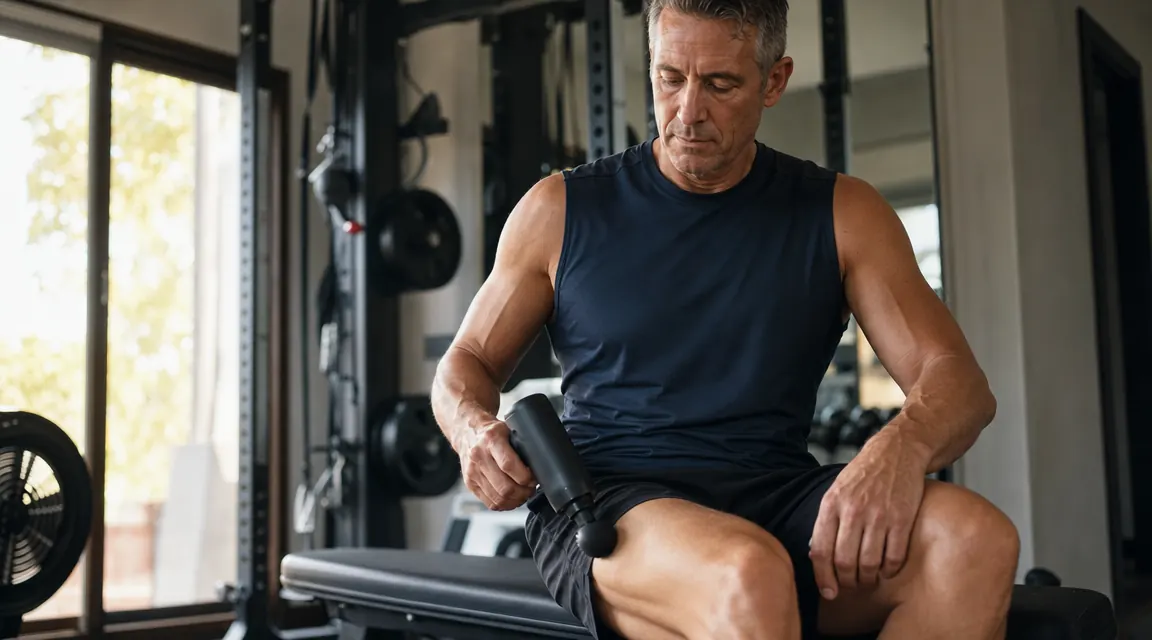
Six months ago I was doing what I had been doing for three years: foam rolling for ten minutes after every workout, stretching my quads before bed, and still waking up stiff the morning after any serious lower body session. I am 44, I train five days a week, and the soreness was not debilitating, but it was compounding. By Thursday of a hard week my legs felt like they belonged to someone older. A training partner mentioned the TOLOCO massage gun almost offhandedly, the way people mention things they assume you already know about. I ordered it that night.
I want to be upfront about what this review is and is not. It is six months of daily use on one body, not a clinical trial. I cannot tell you this gun will do exactly what it did for me. But I can tell you specifically what changed, when it changed, and where the product fell short, so you can make a decision based on something real.
The Quick Verdict
A capable, quiet percussion massager that genuinely shortens soreness recovery time, held back slightly by inconsistent head attachment quality and a learning curve on pressure technique.
Amazon Check Today's Price →Still waking up sore two days after leg day? This is the tool that finally changed that for me.
The TOLOCO percussion massager ships with 15 interchangeable heads, runs quietly enough to use while watching TV, and costs a fraction of the Theragun alternatives. Check current pricing before the next one sells out.
Amazon Check Today's Price on Amazon →How I Have Used It Over Six Months
My routine is consistent: five workouts per week, split between two lower body days, two upper body days, and one full-body conditioning session. The TOLOCO became part of my post-workout cooldown from day one. I use it within thirty minutes of finishing a session, always on the muscle groups I worked that day. Lower body days get ten to twelve minutes split between quads, hamstrings, and calves. Upper body days get eight minutes on lats, traps, and whatever forearm pump carried over from pull work.
I started on speed level two out of five, which the manual suggests for warm muscle tissue. That stayed my default setting for the first eight weeks. Around week ten I started experimenting with level three on larger muscle groups like quads and glutes, where the extra percussion depth actually reaches the tissue rather than just vibrating the surface. I have used level four exactly twice, both times on a particularly knotted area of my left hip flexor after a heavy deadlift session. It is intense. You need warmed-up tissue and a confident grip to use it without the head skipping off the skin.
I also tested it before workouts as a warmup tool for the first three weeks, and stopped. Pre-workout percussion on cold muscle felt uncomfortable on my joints and I did not notice a performance difference. This gun earns its place post-workout, not pre.
What Actually Changed at Week 2, Week 6, and Month 4
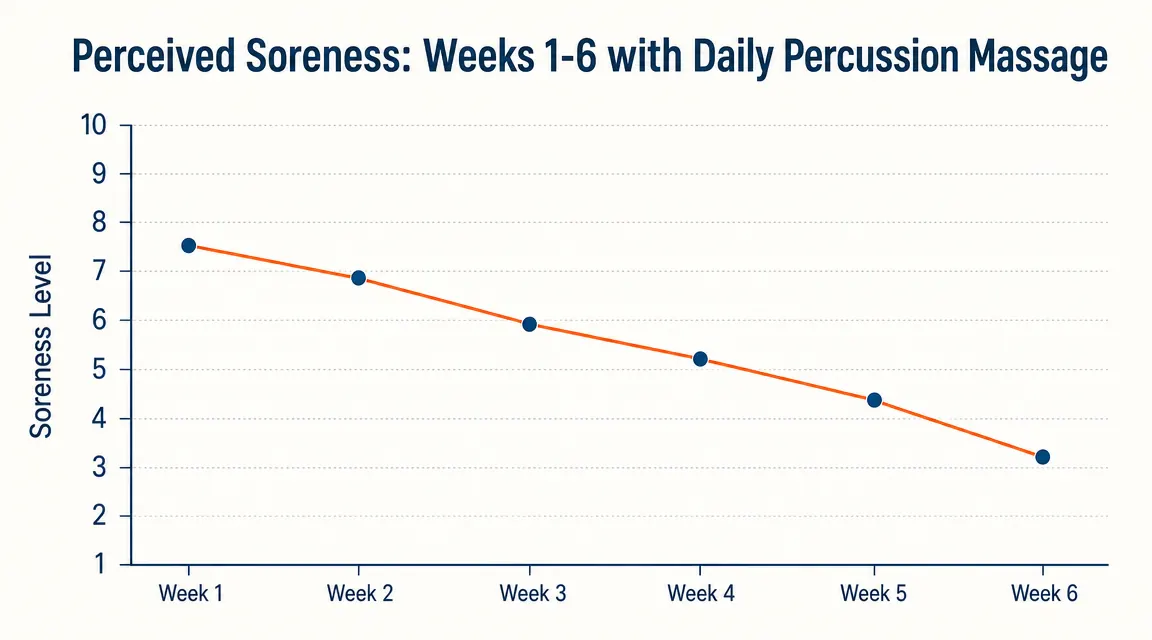
Week one was nothing remarkable. I was sore after leg day, same as always. The gun felt good in the moment, that same immediate relief you get from any pressure on fatigued muscle. I went to bed expecting the same two-day soreness drag and mostly got it, though it felt slightly blunted by the second morning. I did not attribute that to the gun yet.
Week two is when I noticed something. My quads on a Wednesday morning, two days after a Monday squat session, were noticeably less angry than usual. Not gone, but the kind of soreness I associate with day three of recovery, not day two. I started paying closer attention.
By week six the pattern was clear and consistent. Heavy lower body sessions were producing peak soreness at about thirty-six hours instead of forty-eight, and the soreness itself felt less deep, more surface-level, easier to move through. I was training on legs that had recovered enough to work again instead of legs I was managing around. That is a meaningful difference across a full training week.
Month four brought a different kind of observation. A knotted area in my left upper trap that had been a recurring problem for over a year, something I assumed was postural and permanent, responded to three weeks of nightly two-minute sessions with the flat head attachment. Not gone entirely, but loose enough that I stopped waking up with the neck tension that used to be routine. I did not expect that.
By week six, peak soreness was arriving at thirty-six hours instead of forty-eight. I was training on legs that had recovered enough to work, not legs I was managing around.
The 15 Heads: Which Ones I Actually Use
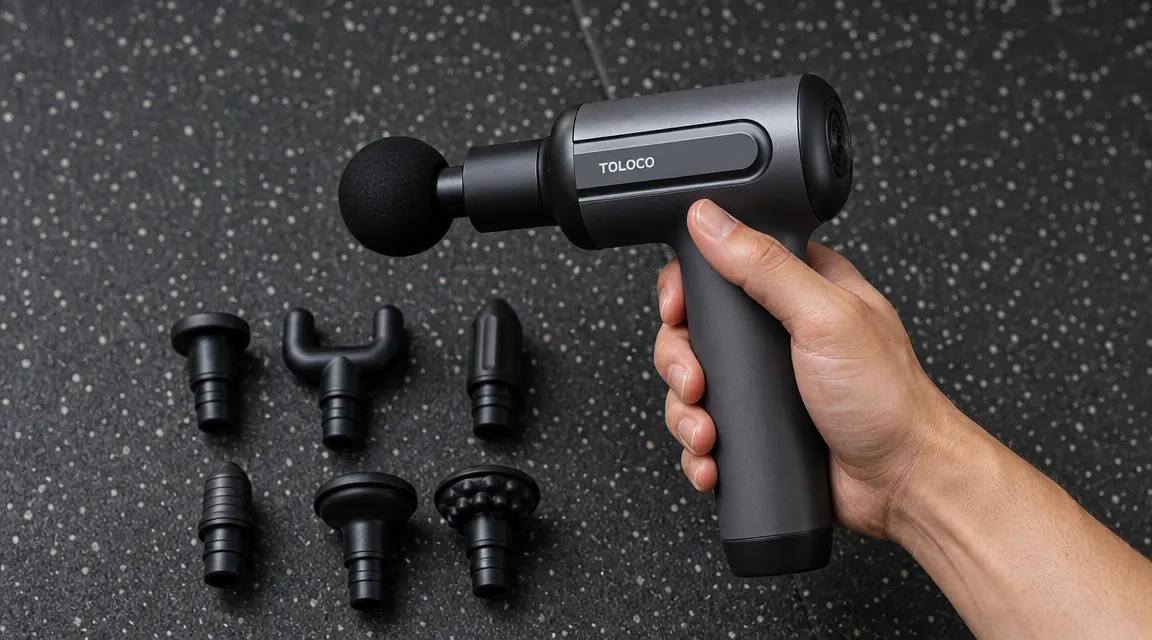
The TOLOCO comes with fifteen interchangeable heads, which sounds like more than it is. In six months I have used four of them with any regularity. The large round ball head is the workhorse for quads, glutes, hamstrings, and upper back. The flat head is what I reach for on calves and the trap area. The bullet head, which is the narrow pointed one, gets used on targeted knots and around the hip flexor attachment point near the anterior superior iliac spine. The fork head works well on the Achilles and either side of the spine, though you need light pressure there.
The remaining eleven heads have been used once or twice out of curiosity. A few feel redundant. The spiky ball head, for example, sits somewhere between the large ball and the flat head without doing either job better. This is not a complaint about value, the core four heads justify the price on their own. It is just honest context so you know the fifteen-head count is partly a marketing number.
Head attachment quality is where I have one real gripe. Two of the fifteen heads arrived with a slightly loose fit in the barrel. They do not fall out during use, but there is a faint rattle when you move the gun between muscle groups. It is minor and it has not gotten worse, but it is noticeable on the quieter speed settings and feels slightly cheap on a gun that is otherwise solid.
Motor Noise, Battery Life, and Daily Usability
The silent motor claim is mostly accurate at low and medium speeds. On levels one and two, the TOLOCO is quiet enough to use in a living room while someone else watches TV, generating a low hum rather than the loud mechanical thump I associate with older percussion guns. Level three is audible from across a room but not intrusive. Levels four and five are the exception, producing a genuine buzz that would bother a sleeping partner in the same bed. In practice this has not been an issue because I rarely use those levels.
Battery life has held up across six months of daily use. A full charge covers five to six sessions of ten to twelve minutes each, meaning I charge it about once a week. Charging is via a proprietary cable, which is the one design choice I dislike. The cable is short, the port is on the body of the gun rather than the base, and losing the cable would mean buying a replacement rather than substituting a USB-C. I taped mine to the charger station so it stays in one place.
The grip is comfortable for my hand size, medium-large, and the weight is manageable for reaching upper back and rear shoulder without awkward arm positioning. Smaller-handed users may find the handle slightly thick, particularly for extended upper back sessions where you are reaching across your body.
What I Liked
- Genuinely reduced post-workout soreness duration by roughly twelve hours over six months of consistent use
- Quiet enough at levels one and two for living room use without bothering others
- 15 heads cover most recovery needs, with the core four being genuinely useful
- Battery holds a full week of daily sessions between charges
- Produces real deep-tissue percussion, not just surface vibration, at levels two and three
- Well under $60 for performance that competes with guns costing two to three times as much
Where It Falls Short
- Two of the fifteen attachment heads arrived with a slight rattle, suggesting inconsistent manufacturing quality control
- Proprietary charging cable is a long-term reliability risk if lost or damaged
- Level four and five are too intense for most use cases and louder than marketed
- No built-in timer or auto-shutoff to guide session length
- Grip can feel thick for smaller hands during rear shoulder and upper back work
How It Compares to Just Stretching and Foam Rolling
I want to address what most people reading this review are actually weighing. You probably already have a foam roller. You probably already stretch. The question is whether percussion massage does something different enough to justify another piece of equipment and another step in your cooldown routine.
My honest answer, after six months, is yes, and the difference is specifically about depth and speed of recovery rather than any magical mechanism. A foam roller applies broad, sustained pressure across a muscle belly. Stretching lengthens tissue passively. Percussion massage drives rapid, repetitive impact into tissue at a speed and depth that is physiologically different from either of the other modalities. It does not replace foam rolling or stretching. It works alongside them by addressing a different part of the recovery equation. On my hardest training days I do a short foam roll, then gun the worked muscles, then stretch. That combination shortened my two-day soreness to closer to one day, and that is worth ten minutes of additional post-workout time.
If you are considering skipping the foam roller entirely and just using the gun, I would not recommend it. The broad-pressure myofascial work a roller does is not replicated by a massage gun. They are complements, not substitutes. For a practical guide to combining both tools effectively, see our post-workout massage gun guide.

Who This Is For
The TOLOCO massage gun makes the most sense for people who train consistently three or more days per week and feel the compounding soreness of a real training load. That means it suits gym-goers running push-pull-legs splits, runners logging thirty-plus miles a week, and recreational athletes who play hard on weekends and need to feel okay by Monday morning. If you train twice a week with moderate intensity, the soreness problem this gun solves is probably not severe enough to justify it. If you train hard and often, it is one of the most practical recovery tools at this price point. For a more detailed breakdown of how the TOLOCO stacks up against premium options, see our TOLOCO vs Theragun comparison.
Who Should Skip It
Percussion massage is not appropriate for everyone. If you have active muscle or joint inflammation, a recent soft tissue injury, blood clot history, or neuropathy, this is not the tool for you without a conversation with a physician first. Beyond medical considerations, skip this gun if you want a premium build with tight tolerances and an app-connected experience. The TOLOCO is a capable workhorse but it does not feel like a precision instrument. The Theragun Pro or Hypervolt Plus are the right comparison there, at three to five times the price. If budget is not a constraint and build quality matters more to you than value, spend accordingly.
Six months in, I reach for this gun after every single training session. It earned its place on the shelf.
The TOLOCO percussion massager has 62,000-plus Amazon reviews and a 4.4-star rating for good reason. If you train hard and wake up sore, this is the most cost-effective tool I have found for shortening that recovery window. Check current pricing before stock fluctuates.
Amazon Check Today's Price on Amazon →